
Your Custom Text Here
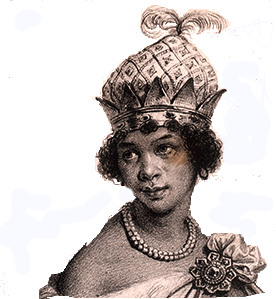
Queen Nzinga Mbande of Angola: Africa’s Female Warrior
-
Long ago, on the western coast of Southern Africa, there stood a powerful kingdom called Ndongo.
It was home to the Mbundu people.
They farmed the fertile land, fished in the rivers, hunted and raised livestock. They shaped iron into tools for farming and weapons for protection. They made pottery, wove cloth, carved wood and created baskets with careful hands.
Traders travelled along inland paths and coastal routes, carrying food, iron, cloth, salt, livestock and other goods from one community to another.
Ndongo grew in wealth.
It grew in influence.
And at the centre of the kingdom stood its ruler, King Ngola Kiluanji Kia Samba.
One day, one of the king’s wives, Kengela ka Nkombe, gave birth to a baby girl.
But something went wrong.
The baby’s umbilical cord was wrapped around her neck. The people watched anxiously as it was carefully untangled.
The child survived.
Some believed that her unusual birth was a sign. This child, they said, had entered the world twisting against danger. Perhaps she had been born for an extraordinary life.
The king named her Nzinga Mbande, a name connected to twisting and turning.
Nzinga grew close to her father. In the palace, she sat beside him while leaders discussed war, trade, alliances and the affairs of the kingdom.
She listened.
She watched.
And she learned.
Nzinga also watched the soldier’s train. She studied how they moved, how they protected themselves and how they prepared for battle.
The king saw her interest and allowed her to train beside them.
Nzinga was still young, but she was already learning that leadership required more than strength.
It required patience.
It required courage.
And it required knowing when to speak.
-
For many years, Portuguese traders and missionaries had travelled into the region. They exchanged goods and introduced Christianity.
But trade was not enough for them.
They wanted more.
More land.
More power.
And more people.
The Portuguese had established plantations in Brazil. Those plantations required large numbers of workers, but the Portuguese did not intend to pay them or allow them to live freely.
They began capturing people.
They formed armies, entered Mbundu communities and forced men, women and children from their homes. Those they captured were enslaved and transported across the Atlantic Ocean to Brazil.
The Portuguese carried guns and other powerful weapons.
Nzinga grew up watching her father fight to protect Ndongo.
As the years passed, Portuguese forces moved farther into the kingdom. They built military camps, supported leaders who agreed to work with them and attacked communities that resisted.
They captured people.
They separated families.
Farms were abandoned.
Fear spread through the kingdom.
King Ngola Kiluanji Kia Samba fought to defend Ndongo, but the pressure did not stop.
When the king died, Nzinga’s brother Mbandi became the new ruler.
He inherited a kingdom already in danger.
Some leaders wanted to fight.
Some wanted to negotiate.
Others chose to support the Portuguese.
Mbandi needed someone who could face the Portuguese without fear. He chose his sister.
Nzinga was a trained fighter. She spoke Portuguese and other languages. She understood politics, negotiation and the responsibilities of leadership.
Mbandi sent her to Luanda to speak on behalf of Ndongo.
-
Luanda was a coastal city controlled by the Portuguese.
It had become the centre of Portuguese power in the region and a major port where captured people were taken before being transported across the ocean.
Nzinga did not arrive quietly.
She travelled with a large group of attendants. She wore layers of rich cloth, jewellery around her neck and arms, and colourful feathers in her hair.
The women and attendants who travelled with her were also dressed for the occasion. One carried her royal staff.
People stopped to watch as she passed through Luanda.
They knew someone important had arrived.
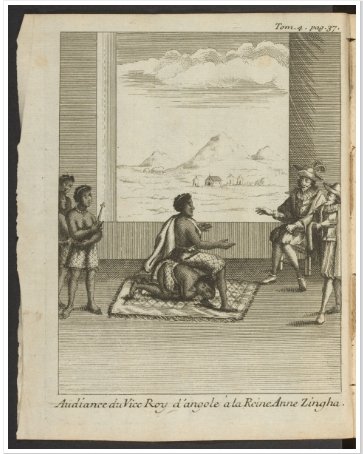
When Nzinga entered the governor’s residence, she saw that a chair had been prepared for him.
But there was no chair for her.
Only a mat had been placed on the floor.
The message was clear.
The governor expected to sit above her.
Nzinga stood still and looked around the room.
Then she turned to one of her attendants and gave a signal.
The attendant lowered to the floor on hands and knees, keeping their back straight.
Nzinga calmly sat on the attendant’s back.
Now she was seated at the same height as the governor.
She looked directly at him.
The meeting could begin.
Nzinga spoke about the Portuguese soldiers who had entered Ndongo. She spoke about the people they had captured and the land they had taken.
She demanded that the Portuguese withdraw their forces and respect the authority of Ndongo.
The governor had expected to intimidate her.
Instead, he found himself facing a woman who refused to be treated as less than a ruler.
Nzinga remained in Luanda while the discussions continued. During her time there, she became a Christian and received the name Ana de Sousa.
The Portuguese believed that her conversion might make her more willing to cooperate with them.
They promised to withdraw from some of the areas they had occupied and to respect Ndongo’s authority.
Nzinga returned home.
-
The Portuguese continued moving farther into Ndongo.
They captured more people, occupied more land and supported leaders who were willing to work with them.
Then King Mbandi died.
Nzinga stepped forward to lead Ndongo.
But not everyone accepted her.
Some leaders argued that a woman could not become ngola, the ruler of the kingdom. Others supported a male heir from her brother’s family.
The Portuguese saw an opportunity.
They supported a man named Hari a Kiluanji and declared him the rightful ruler of Ndongo.
But Nzinga refused to surrender her claim.
She gathered the people who still supported her and prepared to defend the kingdom.
Soldiers joined her.
Displaced families joined her.
People who had escaped capture joined her.
Still, the Portuguese had guns, military camps and powerful allies. Their attacks grew stronger, and Nzinga began losing important parts of Ndongo.
She fled south with her supporters to a place called Ngangela, where her brother Ndala Kisuba owned land.
The Portuguese followed.
They attacked again.
This time, they captured Nzinga’s sisters, Kambu and Funji.
Nzinga was forced to leave Ngangela.
She had lost land.
She had lost supporters.
Her sisters were in captivity.
But she had not lost her determination.
-
Nzinga moved east towards the Kingdom of Matamba.
There, she fought the forces controlling the kingdom, removed its ruler and took leadership of Matamba.
Then she began again.
She brought together soldiers, farmers, traders and families who had been driven from their homes.
She strengthened her army.
She increased trade.
She turned Matamba into the new centre of her power.
People escaping areas controlled by the Portuguese came to Matamba and joined her. Nzinga also formed alliances with powerful military groups in the region.
From Matamba, she continued resisting Portuguese control and claiming her right to rule Ndongo.
At the same time, the Netherlands was at war with Portugal. The Dutch attacked Luanda and took the city from the Portuguese.
Nzinga and the Dutch now shared the same enemy.
So they joined forces.
With Dutch support, Nzinga began fighting to recover the lands the Portuguese had taken from her. Forces connected to the Kingdom of Kongo and other African allies also joined the campaign.
Together, they faced Portuguese soldiers, African troops allied with Portugal and supporters of the Portuguese-backed ruler of Ndongo.
At the Battle of Kombi, Nzinga and her allies defeated the Portuguese-allied army.
It was a major victory.
Her forces regained territory and placed new pressure on Portuguese positions.
For a moment, it seemed that Nzinga might recover much of Ndongo.
After the victory, her forces moved against Massangano, one of the strongest Portuguese fortresses near the Kwanza River.
But Massangano was protected by thick walls and strong defences.
Nzinga had defeated the army at Kombi.
She could not break through the fortress.
The war continued.
The following year, Portuguese reinforcements arrived from Brazil. They recaptured Luanda and forced the Dutch to leave the region.
Without Dutch military support, Nzinga withdrew once again to Matamba.
But she remained its ruler.
And she did not surrender.
-
Years passed.
Nzinga continued resisting Portuguese control, but as she grew older, she began using negotiation more often in her effort to end the fighting.
Christian teachers carried messages between Nzinga and the Portuguese.
Again and again, she demanded the return of her sister Kambu, who had been baptized and given the name Barbara.
The Portuguese had held her for many years.
Nzinga’s other sister, Funji, had been baptized as Dona Graça. While in captivity, Funji secretly sent information to Nzinga about Portuguese military plans.
She placed herself in great danger to help her sister.
Portuguese soldiers later found Funji’s letters in one of Nzinga’s military camps.
When they discovered what she had done, they killed her.
Nzinga had lost a sister.
Still, she continued pushing for peace.
She continued demanding Kambu’s return.
After many years of fighting, Queen Nzinga and the Portuguese finally reached a peace agreement.
The Portuguese had failed to conquer Matamba.
They had failed to remove Nzinga from power.
They recognized her as the ruler of Matamba and agreed to stop attacking the kingdom.
They also released Kambu and allowed her to return home.
Nzinga continued ruling Matamba.
She strengthened trade, worked to maintain peace and prepared Kambu to become the next ruler.
Queen Nzinga Mbande died peacefully in Matamba at about eighty years old.
After her death, Kambu became the ruler of Matamba.
-
Today, statues, streets, books and cultural works continue to honour Queen Nzinga Mbande in present-day Angola.
She is remembered as a powerful and experienced leader who spent much of her life protecting her people and defending her right to rule.
She did not win every battle.
She did not recover everything that had been taken.
But she refused to disappear.
When she lost Ndongo, she built power in Matamba.
When military alliances failed, she changed her strategy.
When the Portuguese tried to replace her, she continued ruling.
When they tried to intimidate her, she sat at their height and looked them directly in the eye.
The Kingdom of Matamba remained independent for many years. The Portuguese did not gain complete control of the region during Nzinga’s lifetime.
Centuries after her death, Portugal gained wider control over Angola. Angolans later fought against Portuguese colonial rule.
On November 11, 1975, Angola became an independent country.
Across Africa and around the world, many women have risen against foreign occupation, injustice and oppression.
But Queen Nzinga’s story continues to stand apart.
It is the story of a child who listened closely.
A woman who learned to lead.
A ruler who knew when to fight and when to negotiate.
And a queen who refused to sit below anyone.
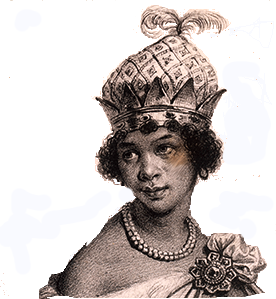
Queen Nzinga Mbande (Anna de Sousa Nzinga)
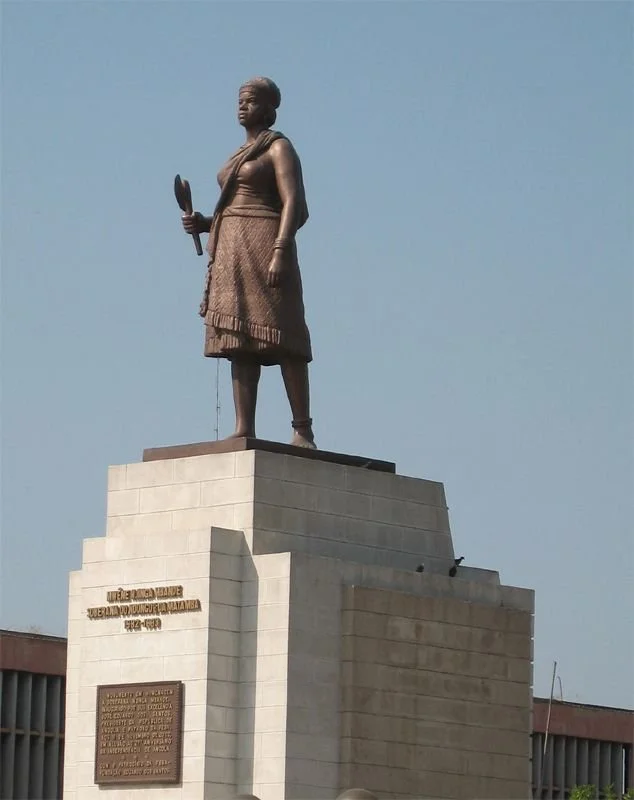
Military Museum in Luanda, Angola.